Hot-Dip Galvanized Bolts for Solar Mounting: ISO 1461 Coating Guide
---
Introduction: The Fastener Is the Weakest Link in a Solar Structure
Solar mounting systems are designed for 25-year asset life, and the structure is usually protected by hot-dip galvanizing. But the bolted connections — exposed to rain, condensation, chloride in coastal sites, and temperature cycling — depend on the quality of the fastener coating. A galvanized bolt that loses its coating in year five will be a maintenance headache and a warranty claim in year eight.
Hot-dip galvanizing is the standard protection for solar mounting steel, and for the fasteners that join it. But galvanized fasteners behave differently from plain bolts: the coating changes thread dimensions, friction, and strength calculations. This guide explains what to specify.
Section 1: What Hot-Dip Galvanizing Does (and Does Not Do)
Hot-dip galvanizing coats steel with a zinc layer (with iron-zinc alloy layers) by immersion in molten zinc. The coating protects by two mechanisms:
- Barrier protection: the zinc layer shields the steel from the environment.
- Cathodic protection: where the coating is damaged, zinc corrodes preferentially and protects the exposed steel.
For fasteners, the practical result is a durable, low-maintenance coating suitable for outdoor solar structures. The limits:
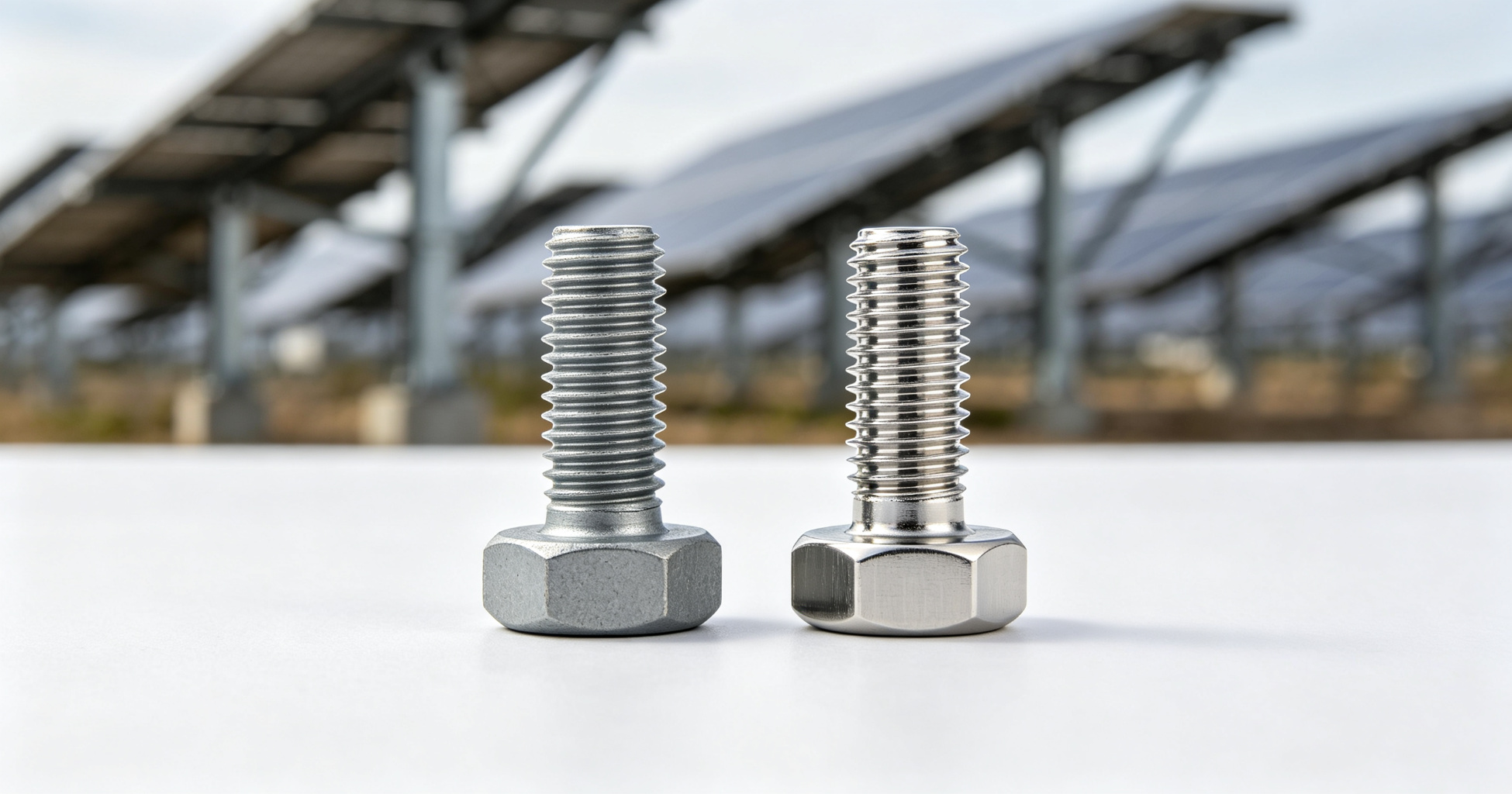
- Not a replacement for stainless steel in severe environments. In marine-coastal sites (high chloride), inside coastal splash zones, or where the atmosphere is aggressive, galvanized fasteners may not reach the design life — stainless (A2/A4) or Zn-Al-Mg coated fasteners may be required.
- Coating thickness and quality must be controlled, or the protection is cosmetic only.
Section 2: ISO 1461 and ISO 10684 — the Standards That Matter
Two standards govern galvanized fasteners in European/international solar projects:
- ISO 1461 — hot-dip galvanized coatings on fabricated iron and steel articles. This is the general structural standard and the one most mounting-system drawings reference.
- ISO 10684 — fasteners (bolts, screws, studs) with hot-dip galvanized coatings. The fastener-specific standard, with its own coating thickness table and thread requirements.
Why the distinction matters: ISO 10684 is the applicable fastener coating standard (thread fit, coating thickness, and strength after galvanizing for bolts, screws, and studs), while ISO 1461 applies to fabricated steel articles generally. If the drawing says only "galvanized per ISO 1461", the fastener-specific requirements of ISO 10684 should still be applied to the bolting.
Coating thickness: typical average thickness for fasteners is 40–65 µm for M12–M24 sizes, depending on the nominal diameter and the material thickness (per the ISO 10684 / ISO 1461 tables). The requirement should be written as an average with a minimum, e.g., "average ≥ 50 µm, minimum ≥ 40 µm" — not as a single number with no minimum.
Section 3: Thread Fit After Galvanizing — the Detail That Causes Rejects
A bolt hot-dip galvanized with the coating on its finished threads will not assemble with a standard nut. The zinc layer adds roughly 40–70 µm per surface, which consumes the thread clearance.
The standard solutions:
- Nuts with oversize tapped threads — the nut is tapped larger than standard after galvanizing (typically tapped to 6H with an allowance, or a specified oversize per ISO 10684 / ASME B18.2.8 for inch sizes). This is the normal approach: the bolt is galvanized on finished threads, the nut is tapped oversize.
- Cutting the threads after galvanizing — the coating is removed from the thread, losing corrosion protection at the thread and inviting thread corrosion; generally avoided unless required.
- Coating thickness control at the thread — keeping the coating at the thread within the specified range so standard fit is maintained where the design allows.
Specification rule: state that nuts shall be tapped oversize to accommodate the galvanized coating (per ISO 10684 or the applicable standard), or specify a system where thread clearance is verified by gauging with a coated nut.
Section 4: Strength and Embrittlement — What Changes After Galvanizing
- Property class reduction: hot-dip galvanizing involves immersion at ~450 °C. For heat-treated high-strength bolts, the temperature can affect the steel's strength. ISO 10684 does include 10.9 in its scope, but with strict hydrogen-embrittlement and heat-treatment controls; in engineering practice 10.9 HDG is usually avoided (or prohibited by the project) because of hydrogen-embrittlement risk from pickling and temper-softening at the galvanizing temperature. Solar mounting structures commonly use 8.8 galvanized bolts; where 10.9 strength is required with corrosion protection, specify zinc-flake (ISO 10683) or stainless fasteners instead.
- Hydrogen embrittlement: the acid pickling step before galvanizing can introduce hydrogen. Risk is highest in high-strength steel (≥ 10.9). Control measures: avoid pickling inhibitors that increase hydrogen, use proper baking, and restrict galvanizing to classes where the risk is manageable.
- Strength of the connection: the zinc coating is soft; the effective thread stripping strength depends on the nut material and thread engagement, which the oversize tapping affects. The connection design should account for the galvanized assembly's characteristics.
If the design requires 10.9 with corrosion protection in a solar structure, the common alternatives are zinc-flake (ISO 10683) coatings or stainless fasteners, rather than HDG.
Section 5: Service Life and Environment Selection
Coating life depends on the environment and the coating thickness. The standard correlation (ISO 9223/9224 style mapping, commonly used for galvanized steel in atmospheric exposure):
| Environment | Typical zinc corrosion rate | HDG 50 µm expected life |
|---|---|---|
| Rural / low pollution | Low (~0.5 µm/yr) | 20+ years |
| Urban / industrial | Moderate (~1–2 µm/yr) | 15–25 years |
| Coastal (moderate chloride) | Higher (~2–4 µm/yr) | 10–20 years |
| Marine splash / aggressive chloride | Severe (4+ µm/yr) | < 10 years — consider stainless |
For solar plants in coastal or desert-coastal sites, specify either thicker galvanizing (≥ 70–85 µm average) or stainless / Zn-Al-Mg fasteners at high-risk locations (seawater proximity, salt-laden wind, ground-mount racks near the sea).
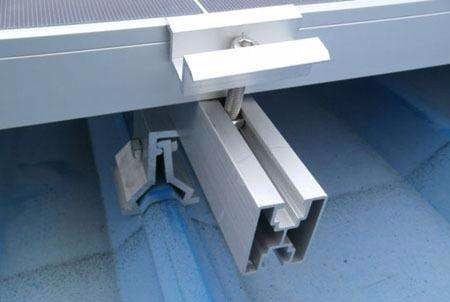
The mounting design should also avoid crevices and dissimilar-metal contacts (steel-galvanized bolts in direct contact with aluminum profiles) unless isolated — galvanic corrosion accelerates the aluminum or the coating at the contact. Where contact is unavoidable, specify an isolating layer (e.g., EPDM washers/gaskets or insulated washers) between the galvanized fastener and the aluminum member.
Section 6: Specification Checklist for Galvanized Solar Bolts
- Coating standard: ISO 10684 (fasteners) and/or ISO 1461 (structural), with the average and minimum thickness specified
- Property class: 8.8 typical for galvanized; confirm 10.9 only with supplier evaluation
- Thread fit: oversize-tapped nuts to accept the coating; gauging verified with coated assembly
- Size and length: as per the mounting drawing, with correct grip length
- Environment: state whether coastal/industrial/rural, to set the thickness and material decision
- Tests and documents: coating thickness reports, material certificates (3.1 where required), and, for high-strength classes, hydrogen embrittlement control confirmation
- Marking and packaging: VCI packaging for storage, lot marking for traceability
---
FAQ
Q1: What is the difference between ISO 1461 and ISO 10684? ISO 1461 covers hot-dip galvanized coatings on steel articles generally; ISO 10684 is the fastener-specific standard covering coating thickness and thread-fit requirements for galvanized bolts, screws, and studs. For fasteners, apply both.
Q2: Can I galvanize 10.9 bolts? Galvanizing 10.9 bolts is possible but restricted: the ~450 °C immersion can affect heat-treated strength, and pickling adds hydrogen embrittlement risk. ISO 10684 typically addresses classes up to 8.8. If 10.9 plus corrosion protection is required, consider zinc-flake (ISO 10683) or stainless.
Q3: Why can't a galvanized bolt fit a standard nut? The zinc coating adds tens of microns to the thread profile, consuming clearance. Nuts are tapped oversize (or the thread allowance is managed) so the coated bolt assembles correctly.
Q4: How long does galvanizing last on a solar structure? It depends on environment and thickness: 20+ years in rural sites at standard thickness, less in coastal or industrial sites. Coastal projects need thicker coating or stainless fasteners at high-risk positions.
Q5: Should I use galvanized or stainless fasteners on a solar rack? For inland, low-chloride sites, galvanized 8.8 bolts are standard and economical. For coastal or aggressive sites, stainless (A2/A4) or Zn-Al-Mg fasteners are more reliable over the 25-year design life.
Q6: Do I need coating thickness certificates? For project QA, yes — coating thickness reports per lot (with average and minimum values) plus material certificates are the standard documentation package for galvanized solar bolting.
---
Need galvanized fasteners for your solar mounting project? Send us your drawing with the sizes, property class, and site environment, and we will confirm coating thickness, oversize-tapped nuts, and the full documentation package within one working day. Coastal and desert-coastal projects: we will flag the material decision (HDG vs. stainless) before quoting.